The Goon Show: How Spike Milligan's Radio Madness Rewired British Comedy
Before Python, before Cook and Moore, there was The Goon Show, a chaotic explosion on the BBC airwaves. This radio phenomenon, driven by the singular genius of Spike Milligan, didn't just entertain; it fundamentally reshaped the landscape of British humor.
The Goon Show, which first crackled onto the BBC Light Programme in 1951, wasn’t merely a radio program; it was a detonation. In a post-war Britain still clinging to its stiff upper lip, the anarchic brilliance cooked up by Spike Milligan, Peter Sellers, Harry Secombe, and Michael Bentine tore through the genteel fabric of established comedy, forging a new path of surrealism, non-sequitur, and sheer, glorious madness. This wasn't just humour; it was a declaration of war on conventionality, a blueprint for the comedic revolutions that would follow.
The Genesis of Anarchy
Before the Goons, British radio comedy often operated within well-understood bounds: gentle puns, character-driven sketches, and a certain deference to authority, even when satirizing it. Shows like ITMA (It's That Man Again) had established popular catchphrases and recurring characters, but they rarely strayed from a linear narrative or a logical progression of jokes. Milligan, a veteran of wartime entertainments, brought a different sensibility to the microphone. Alongside fellow ex-servicemen Sellers, Secombe, and Bentine, he infused the airwaves with a manic energy, crafting narratives that collapsed into absurdity, often within the space of a single breath. The initial incarnation, Crazy People, quickly morphed into The Goon Show, cementing the core quartet and a style of writing that was uniquely Milligan's: a frantic, stream-of-consciousness assault on logic, populated by an unforgettable gallery of voices.
A Symphony of Sound and Nonsense
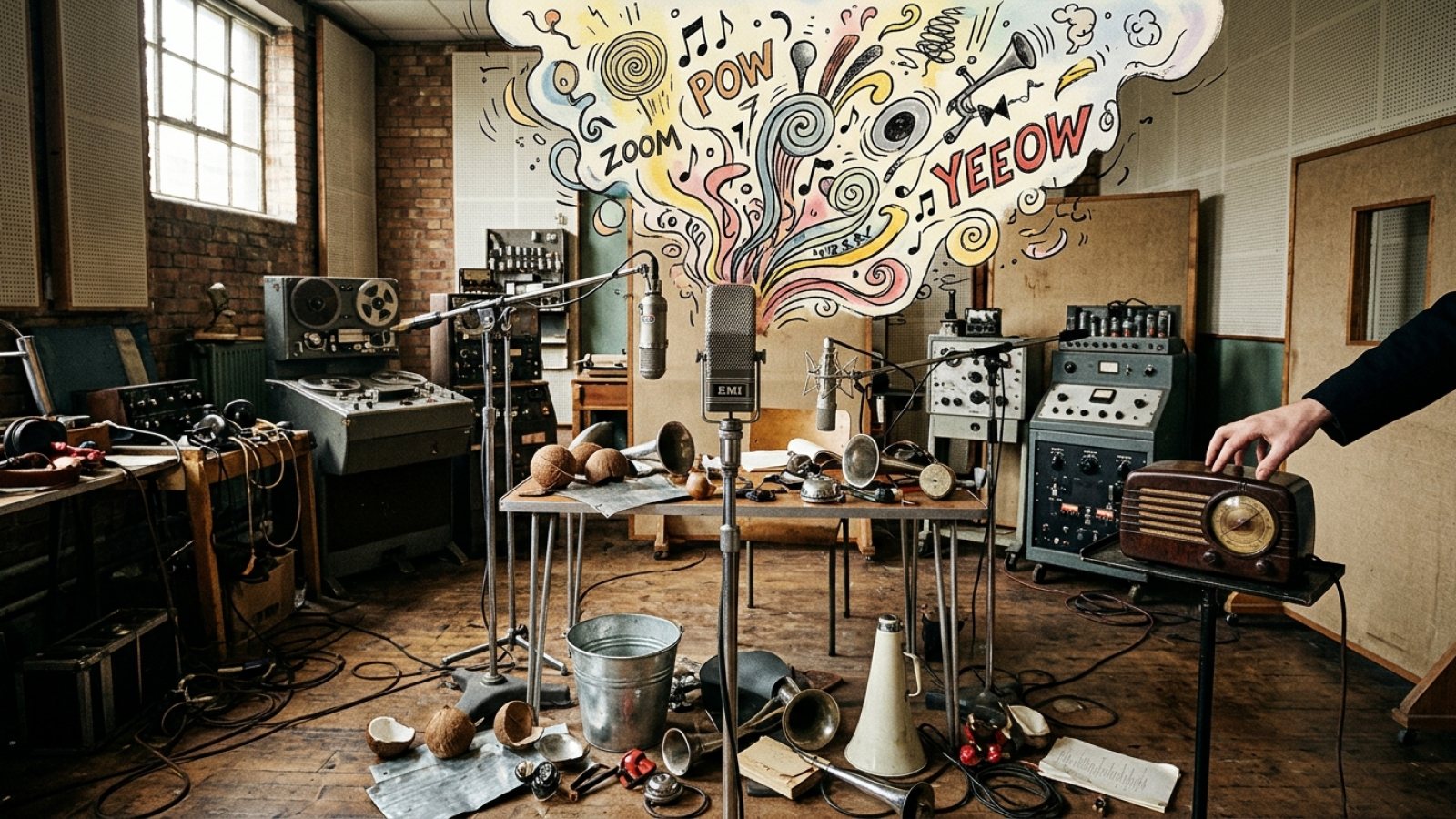
What made The Goon Show so revolutionary was its audacious use of sound. While radio had always relied on sound effects, the Goons weaponized them. A galloping horse might be a coconut, a car crash a collapsing pile of junk, but the humour wasn't in the realistic depiction; it was in the deliberate, often self-aware, artificiality. Characters like Eccles ("Hello, folks!") or Major Bloodnok ("You rotten swine!") became instantly recognizable not just by their voices, but by the sonic landscapes they inhabited. Milligan's scripts were a dizzying tapestry of verbal dexterity and unexpected sonic punctuation, often breaking the fourth wall to comment on the show itself or the BBC. This meta-comedy, coupled with rapid-fire shifts in plot and character, created a world where anything could happen, and usually did – from an invasion of Scotland to a quest for a giant squid, all underpinned by a deep, irreverent affection for the absurd. It was the sound of a generation kicking against the traces, finding joy in chaos.
The Goon Legacy: Rewiring the Brain
The impact of The Goon Show on subsequent generations of British comedians is impossible to overstate. It wasn't just admired; it was absorbed, its DNA becoming a foundational element in the development of modern British humour. The surreal non-sequiturs, the anti-establishment bite, the playful dismantling of narrative convention – all these elements found powerful echoes in the satirical boom of the early 1960s. Peter Cook and Dudley Moore, with their iconic club The Establishment and later their TV show Not Only… But Also, clearly owed a debt to the Goons' pioneering absurdity. The team behind Beyond the Fringe – Cook, Moore, Jonathan Miller, and Alan Bennett – further refined the art of intelligent, observational satire, but the Goons had already laid the groundwork for pushing boundaries. Most famously, the entire edifice of Monty Python's Flying Circus can be seen as a direct descendant, taking the Goons’ radio-borne surrealism and translating it with brilliant ingenuity into visual form. John Cleese himself noted that The Goon Show taught him that “there were no rules.” Its influence rippled across the comedy landscape, from the alternative comedy movement of the 1980s to modern podcasting.
The Goon Show didn't just entertain millions; it taught them to laugh at the unexpected, to embrace the illogical, and to question the established order. It proved that radio, often seen as a medium for earnest drama or light entertainment, could be a playground for radical comedic experimentation. Spike Milligan’s singular vision, brought to life by his brilliant co-stars, didn’t just make people laugh; it irrevocably changed the way British comedy spoke to its audience, laying down a gauntlet of joyful, glorious anarchy that still reverberates today.
