The next time you settle in for a sitcom, spare a thought for the 16th-century Italian travelling players, because odds are, their influence is still very much on screen. Before there were networks, before sound stages, before even the notion of a written script as we know it, there was Commedia dell'Arte: an explosive, improvisational form of theatre that gave us the stock characters and comedic dynamics that continue to define popular entertainment, from stand-up to our most beloved television shows.
Born in the bustling squares and courts of Italy around 1550, Commedia dell'Arte emerged from a rich European tradition of street performance, jestering, and folk plays. Unlike the more formal, often religious, theatrical productions of the era, Commedia was utterly mercenary, performed by professional actors (a novel concept at the time) for anyone who would gather. They didn't rely on elaborate sets or even a fixed script; instead, troupes worked from a basic plot outline, known as a 'scenario,' filling in the dialogue and action with their wits, physical comedy, and a repertoire of established jokes and bits called 'lazzi.' What truly cemented its place in history, however, were the instantly recognizable, often masked, archetypes that populated these performances.
The Masks and the Message
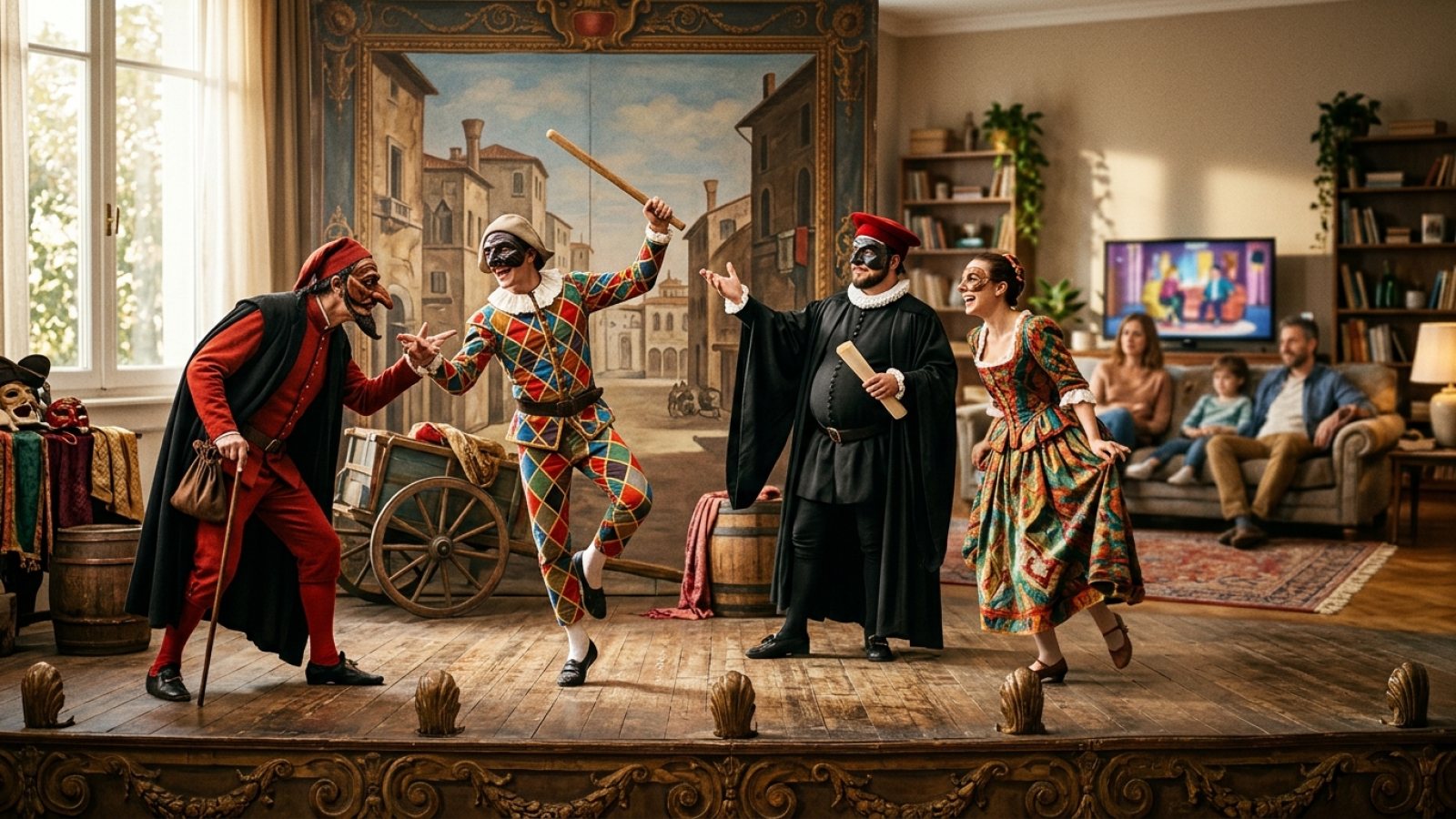
These were characters you knew immediately, no matter the language barrier or the specific storyline. There was Pantalone, the miserly, often lecherous, old merchant, usually with a long nose and a dark red costume, forever outwitted or robbed. His foil was Arlecchino (Harlequin), the clever, acrobatic, but sometimes dim-witted servant, often wearing a patched costume and a black half-mask. The pompous and verbose Il Dottore (The Doctor) or Il Capitano (The Captain), a cowardly, boastful soldier, would round out the 'vecchi' or old characters, representing authority figures ripe for mockery.
Then came the 'innamorati,' the young lovers, beautiful and often unmasked, whose romantic entanglements drove much of the plot. And finally, the 'zanni,' or servant characters, like Colombina, the sharp-witted maid who often served as the voice of reason or the architect of schemes, frequently outmaneuvering both her masters and the other zanni. These masks and personas weren't just costumes; they were shorthand for entire comedic personalities, instantly understood by audiences across Europe as these troupes toured relentlessly for centuries.
Still Playing the Room
Fast forward to the 20th and 21st centuries, and a quick flick through any sitcom channel reveals that these core Commedia dynamics are still running the show. Think of the tight-fisted, often gullible boss character in countless office comedies – a direct descendant of Pantalone. From the tight-fisted Mr. Burns in The Simpsons to the hapless employer in any number of workplace comedies, the blueprint is clear. The lovable, bumbling trickster, perpetually trying to get one over on authority, or simply falling into chaotic situations, echoes Arlecchino; consider Homer Simpson or even the physical comedy of Mr. Bean, whose silent antics are pure lazzi.
The verbose, self-important but ultimately clueless intellectual? That's Il Dottore, reincarnated as the high-minded but socially inept Dr. Frasier Crane in Frasier or the brilliant but insufferable Sheldon Cooper in The Big Bang Theory. The boastful, often incompetent authority figure, full of hot air but little courage, is Il Capitano; picture Ron Burgundy from Anchorman or even Jake Peralta’s early, more self-aggrandizing days on Brooklyn Nine-Nine. The Innamorati are the bedrock of any will-they-won't-they sitcom romance, from Ross and Rachel in Friends to Jim and Pam in The Office. And the clever, grounded maid, Colombina, thrives as the quick-witted best friend or the competent assistant, like Monica Geller in Friends or Amy Santiago in Brooklyn Nine-Nine, often the most intelligent person in the room.
An Enduring Legacy of Lazzi
Beyond specific characters, Commedia bequeathed to us the very structure of comedic interplay: the setup and punchline, the recurring gags, the physical pratfalls (the 'slapstick' originated from the actual wooden bat, or 'batacchio,' used by Arlecchino), and the vital importance of ensemble chemistry. The improvisational spirit of stand-up, the recurring character bits in sketch comedy, and the tight, repartee-driven dialogue of modern sitcoms all owe a debt to those masked players who performed without a net. They understood that certain character types, pitted against each other, generate eternal humor. So, the next time a sitcom character makes you laugh with their predictable stubbornness, their flamboyant incompetence, or their sly intelligence, remember the Italian stages of five centuries past. The masks may have changed, but the laughter remains timeless.
