From the Brick Wall to the Earbuds: Stand-Up From the 1970s Club to the Podcast
In the 1970s, comedy found two new homes at once: the late-night sketch show and the dedicated stand-up club. Cable specials carried the club act into the living room, and podcasts later carried the comedian's voice into everyone's ears. Each step changed what a comic could say, and to whom.
For most of the twentieth century, a stand-up comedian was a supporting act. Comics opened for singers in nightclubs, worked the resorts, and hoped for a few minutes on a television variety show. In the space of a few years around 1970, that changed. Comedy got rooms of its own, television shows built around a new kind of sketch, and soon a way to put a comedian's whole act on the screen, uncut. The road from there runs straight to the podcast feeds of today.
Sketch Gets Remade
The first push came from television. On Sunday, October 5, 1969, the BBC broadcast the first episode of Monty Python's Flying Circus at 10:55 at night. It mixed absurd situations, sight gags and sketches that had no punchline at all, linked by animated segues, and its format built on the anarchic style of Spike Milligan, whose radio work is the subject of our story on The Goon Show.
Six years later, on October 11, 1975, NBC aired the first episode of a live late-night show created by Lorne Michaels. It went out under the title NBC's Saturday Night and was hosted by the stand-up comedian George Carlin. As Saturday Night Live, with a repertory cast, a celebrity host and a musical guest each week, it became a training ground for generations of American sketch performers and writers.
A Room of Its Own
At the same time, the stand-up club took shape. The Improvisation opened on April 20, 1963, as a 50-seat after-hours coffee house on West 44th Street in New York, founded by Budd Friedman and Silver Saundors, where Broadway performers could unwind. Comedians began to use it to try out material, and scouts from The Tonight Show and other New York television programmes started coming to look for new acts. By the 1970s it was a stand-up venue, and in 1974 a second Improv opened on Melrose Avenue in Los Angeles.
In April 1972, the comedians Sammy Shore and Rudy De Luca opened The Comedy Store at 8433 Sunset Boulevard, in a building that had once housed the nightclub Ciro's. It began with a 99-seat room. Mitzi Shore began running the club in 1973, bought the building in 1976 and expanded it with a 450-seat main room. She described the club as a showcase and training ground where young comedians could work on their material in front of an audience. Clubs like these, and others that followed across the country, turned stand-up into something a person could build a career on: a nightly practice, with a ladder from open-mic spots to headlining.
The Special, Then the Feed
The club act soon found its way to the screen. On December 31, 1975, the cable channel HBO aired An Evening with Robert Klein, the start of its regular comedy specials. Viewers responded, and on March 20, 1976, HBO launched On Location, a monthly series that presented a comedian's nightclub performance in its entirety and uncut, starting with David Steinberg. A comedian's full club act, uncut, could now reach viewers at home. Cable kept building on the idea: The Comedy Channel launched on November 15, 1989, as the first cable channel devoted entirely to comedy, and after a merger with a rival comedy channel it became Comedy Central, which launched on April 1, 1991.
The next step needed no network at all. On September 1, 2009, the comedian Marc Maron launched WTF with Marc Maron, a podcast he recorded at first in borrowed radio studios and then, for most of its run, in his garage in Los Angeles. Long, candid conversations with other comedians became its signature, and on June 22, 2015, President Barack Obama recorded an episode in that garage. When the show ended on October 13, 2025, it had published 1,686 episodes. Countless other comedy podcasts followed the same route, from a microphone at home straight to listeners' earbuds.
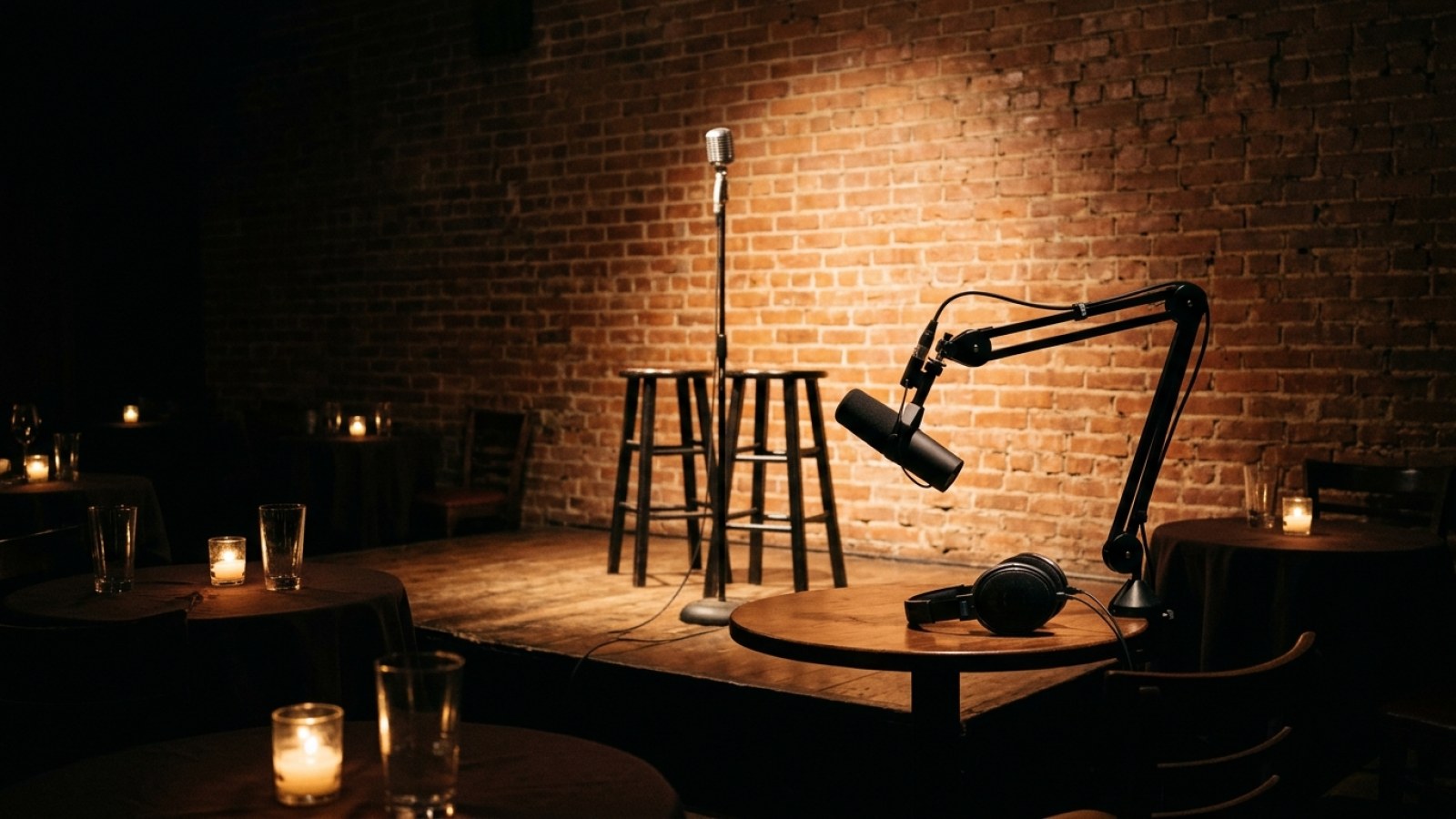
Today the stand-up special is commissioned by streaming services and watched in every country they reach, and the podcast has become a stage of its own, where comics talk, test ideas and build an audience that will later buy a ticket to see them live. The brick-walled room has not gone anywhere. It is still where the jokes are written, one late set at a time.
